

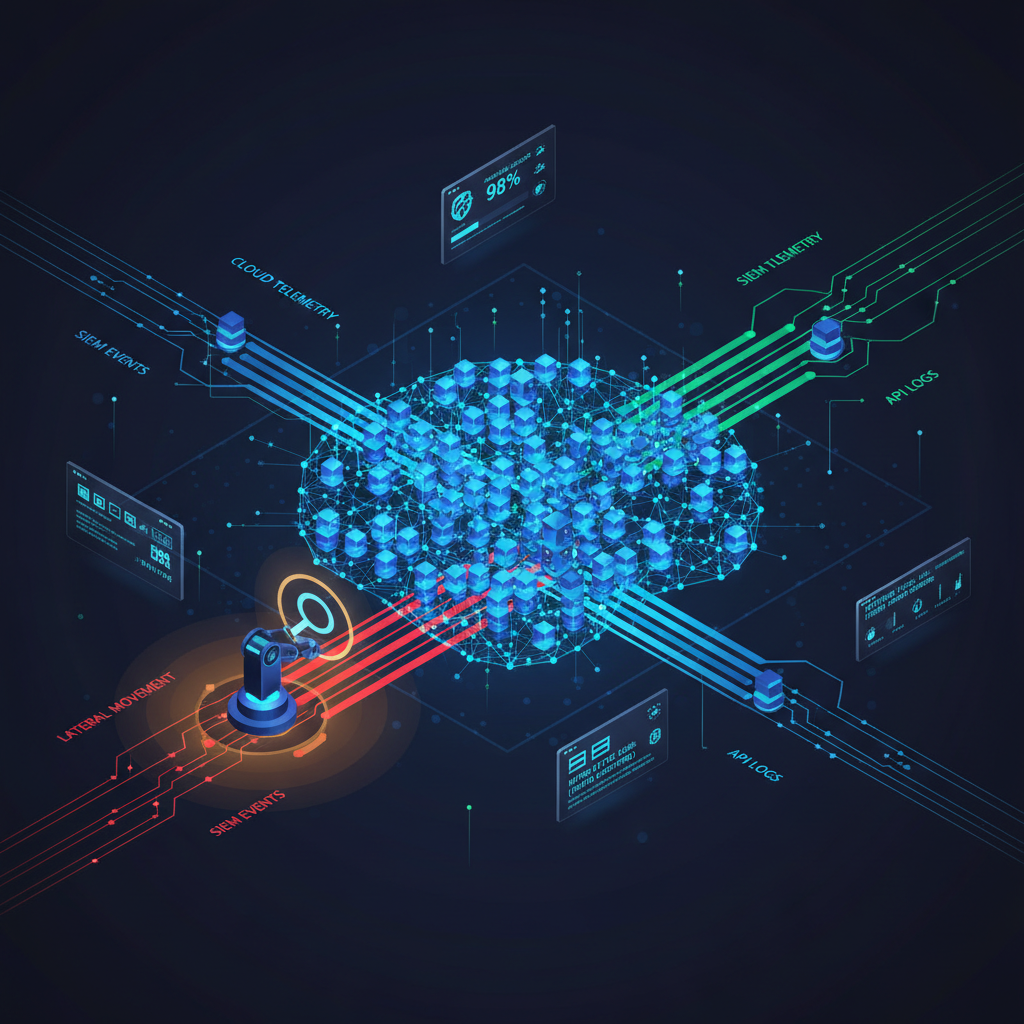
IBM's 2026 Cost of a Data Breach report put the average breach cost at $4.88M — and organizations that deployed AI-powered security tools contained breaches 108 days faster than those that didn't. That's not a marketing number. That's the gap between a bad quarter and a catastrophic one.
AI in cybersecurity has moved well past the hype phase. It's no longer about whether ML models can help security teams — they clearly can. The sharper question is: where does AI actually earn its keep, and where does it still fall flat? Because there are genuine limits here, and security engineers who buy into the full vendor narrative end up with expensive tools that generate alert storms and false confidence.
This guide covers the real benefits of AI in cybersecurity, concrete examples that are working in production environments today, the disadvantages nobody talks about enough, and how to structure an AI-augmented security program that holds up under NIST CSF 2.0 and MITRE ATT&CK alignment requirements.
Why AI Became Non-Negotiable for Security Teams
The attack surface has scaled faster than headcount ever could. A mid-sized company running workloads across AWS, Azure, and GCP — with containerized microservices, CI/CD pipelines pushing daily — generates millions of security-relevant events per day. Traditional SIEM rules can't keep up. Human analysts definitely can't.
Three converging pressures forced the shift:
1. Volume. Cloud-native infrastructure generates telemetry at a scale that requires automated analysis. A single Kubernetes cluster can emit tens of thousands of audit log events per minute. Manual triage is not a strategy.
2. Adversarial sophistication. Modern threat actors use living-off-the-land techniques, abuse legitimate cloud APIs, and chain low-signal behaviors that individually look benign. MITRE ATT&CK T1078 (Valid Accounts) and T1562 (Impair Defenses) are perennially in the top exploited technique categories — precisely because they're hard to catch with static rules.
3. The defender skill gap. There are an estimated 4.8 million unfilled cybersecurity positions globally as of 2026. AI doesn't replace security engineers, but it compresses the experience gap — letting a mid-level analyst operate with the pattern recognition of someone with ten years of threat hunting experience.
The Real Benefits of AI in Cybersecurity
Anomaly Detection at Scale
Classical rule-based detection fails against zero-days and novel attack patterns. AI-powered behavioral analytics — specifically unsupervised and semi-supervised ML models — establish baselines for what normal looks like: typical login times, standard API call volumes, expected data egress ranges. When something deviates, the model flags it.
This is where AI earns the most credibility. Google's SOAR implementation reduced false positive rates by 50% after deploying BERT-based NLP to correlate phishing alert signals. Darktrace's enterprise immune system approach applies similar logic — watch what normal looks like, then surface statistical outliers.
The caveat: baseline quality is everything. A model trained on a misconfigured environment will normalize the misconfiguration. Garbage in, garbage out applies here with serious security consequences.
Vulnerability Prioritization That Actually Reflects Risk
Most organizations have thousands of open CVEs at any given time. CVSS scores alone are a poor prioritization tool — a CVSS 9.8 with no public exploit and no internet-facing exposure is less urgent than a CVSS 6.5 with a weaponized PoC actively being exploited in the wild.
EPSS (Exploit Prediction Scoring System) combined with AI-driven context — asset criticality, network exposure, compensating controls — produces prioritization that actually maps to blast radius. Tools like Tenable One and Qualys TruRisk use ML to surface which vulnerabilities represent real, exploitable paths. This feeds directly into a mature Vulnerability Management program that security teams can defend to the board.
Accelerated Incident Response
Mean time to detect (MTTD) and mean time to respond (MTTR) are the metrics that actually matter post-breach. AI-driven SOAR platforms automate the triage playbook: correlate alerts, look up threat intel, isolate the affected host, notify the on-call team — all within seconds, not hours.
CrowdStrike's Falcon platform, for instance, uses graph-based AI to trace lateral movement across endpoints. When a compromised credential attempts to access a domain controller, the system doesn't just alert — it maps the likely attack path against MITRE ATT&CK and gives responders a head start on containment. That's not theoretical. That's production-grade incident response acceleration.
AI-Powered Code and Secret Scanning
Shift-left security means catching vulnerabilities before they reach production. AI models trained on millions of code commits can identify patterns that static analysis tools miss — not just obvious SQL injection, but subtle logic flaws, insecure deserialization chains, and hardcoded secrets obfuscated through encoding.
SAST tools like Semgrep and Snyk Code have incorporated ML layers to reduce false positive rates and surface higher-confidence findings. Similarly, Secret Detection tooling uses entropy analysis and pattern matching trained on leaked credential datasets to catch API keys, tokens, and certificates that developers accidentally commit. The cost of fixing a secret in a public repo hours after exposure is orders of magnitude higher than catching it pre-commit.
Threat Intelligence Processing
The volume of threat intelligence feeds — IOCs, TTPs, vulnerability disclosures, dark web chatter — is too large for any analyst team to consume manually. NLP models can parse thousands of threat reports daily, extract actionable indicators, map them to MITRE ATT&CK techniques, and surface what's relevant to your specific environment.
Recorded Future and Mandiant Advantage both apply AI to threat intel aggregation. The output isn't a raw feed — it's prioritized, contextualized intelligence that actually changes what your security team does next.
Concrete Examples of AI in Cybersecurity
Phishing Detection
Microsoft Defender for Office 365 uses ML models to analyze email sender reputation, URL patterns, content structure, and behavioral signals simultaneously. The model catches spear-phishing campaigns that bypass traditional signature-based filters — particularly BEC (Business Email Compromise) attempts where the email contains no malicious payload, just social engineering text. You can see how this integrates with broader platform capabilities on the Microsoft Defender resource page.
Cloud Misconfiguration Detection
AI-driven CSPM tools continuously monitor cloud environments against CIS Benchmarks, NIST, and custom policy sets. More importantly, ML models can detect configuration drift — when a previously compliant resource changes state — and correlate drift patterns across accounts to identify systematic misconfigurations rather than one-off errors. Frankly, most legacy CSPM tools still treat every finding as equal-weight. AI-augmented posture management introduces the context layer that makes the difference between a 200-item finding list and a five-item priority queue.
User and Entity Behavior Analytics (UEBA)
Insider threats are notoriously hard to detect with rules. An employee who downloads 10GB of sensitive documents on their last day before resignation doesn't trigger a traditional DLP rule unless you have that exact pattern pre-configured. UEBA models build a behavioral fingerprint for every user and entity. Statistical deviation from that fingerprint — unusual access times, atypical data volumes, new geography — triggers risk scoring that feeds into SOC workflows.
Container and Runtime Security
Falco, the CNCF runtime security project, uses rule-based detection layered with anomaly detection to catch unexpected syscalls in containerized workloads. AI extensions can model what normal container behavior looks like at runtime and flag deviations — a container suddenly spawning a shell, reaching out to an external IP, or reading from unexpected file paths. Combined with Container Image Scanning, this creates defense-in-depth across the container lifecycle.
Advantages and Disadvantages of AI in Cybersecurity
The Advantages Are Real
Speed is the obvious one. AI processes at machine speed — analyzing millions of events in the time it takes an analyst to open a ticket. Consistency matters too: AI doesn't have bad days, doesn't skip steps when tired, and applies the same logic to the millionth alert as it did to the first. For Cloud Security specifically, the ability to monitor dynamic, ephemeral infrastructure that changes continuously is only tractable with automation and AI.
Scalability is the third pillar. As your environment grows — more cloud accounts, more microservices, more CI/CD pipelines — AI-driven security scales horizontally without a proportional increase in analyst headcount.
The Disadvantages Nobody Talks About Enough
False positives are still a major problem. Poorly trained models generate alert fatigue that's arguably worse than no AI at all — analysts tune out noise, and real signals get buried. Deploying AI without investing in model tuning and feedback loops is a trap many teams fall into.
Adversarial ML is an emerging and underappreciated threat vector. Sophisticated attackers can probe AI-based detection systems, identify decision boundaries, and craft attacks that deliberately stay within the model's definition of normal. This is not theoretical — academic research and red team engagements have demonstrated this repeatedly. NIST's AI Risk Management Framework (AI RMF) specifically calls out model evasion as a risk category.
Data poisoning is another concern. If an attacker can influence the training data — through long-term, low-and-slow activity that gets labeled as normal — they can degrade model effectiveness over time. And explainability remains an organizational challenge: when an AI system flags an alert, analysts need to understand why. Black-box models create accountability gaps that regulators increasingly flag under GDPR and NIS2 compliance frameworks.
AI-SPM: Managing the Security of AI Systems Themselves
Here's the angle most security teams aren't thinking about yet: as AI systems become critical infrastructure, they need to be secured just like any other infrastructure component. AI models have attack surfaces — prompt injection, training data extraction, model inversion attacks. The emerging discipline of AI Security Posture Management (AI-SPM) addresses this directly.
AI-SPM tools inventory AI models deployed across an organization, identify misconfigurations in model APIs, detect exposed model endpoints, and monitor for anomalous inference patterns that could indicate adversarial use. As LLM deployment accelerates across enterprises, AI-SPM will be as essential as CSPM is today. The attack surface is real, and most organizations are currently flying blind on it.
Building an AI-Augmented Security Program
A few principles that actually hold up in practice:
Start with data quality. AI models are only as good as the telemetry they consume. Invest in log normalization, consistent asset tagging, and enriched context (asset criticality, environment classification) before layering AI on top. Garbage-in applies here with outsized consequences.
Align to frameworks. Map your AI-driven detections to MITRE ATT&CK techniques. This gives you coverage visibility — which tactics and techniques are you detecting, and which have blind spots? NIST CSF 2.0's Detect and Respond functions provide the governance wrapper.
Maintain human oversight. AI should compress analyst workload, not eliminate analyst judgment. The best implementations use AI for triage and correlation, and humans for decision-making and context injection. Fully autonomous response is appropriate only for clearly scoped, well-understood scenarios — automated quarantine of a known malware hash, for instance.
Treat AI models as assets. Apply Policy-as-Code governance to AI deployments the same way you'd govern cloud resources. Version control your models, audit access to training data, and test for adversarial robustness before production deployment.
The organizations doing AI-driven security well aren't the ones with the most AI tools — they're the ones that integrated AI purposefully into a coherent security architecture, measured outcomes rigorously, and stayed honest about where the technology still has limits. That's the mindset that turns a vendor pitch into a genuine security capability. Explore more technical depth on the Secrails Blog.